Signs of rain, Manila, July 2010

 Lightning storm, Manila, July 2010
Although I didn't really need to, I felt like putting together a second submission with some of the "rejects" from LineCurveTexture, and so The Other Things was born. I didn't compromise on selecting for editting - these are the images that I would select otherwise but that didn't fit in any way into the original project.
I was also trying to get a background transparency to work with pdf 1.4 but to no avail. The intention was that the background frame would disappear when viewing so that the images would be nicely centred on the screen with a natural border.
I'm pretty sure this should be possible, as per pdf sepcs, but can't for the life of me figure out how to get it to work properly. I think it's maybe a viewer issue (yet I use Adobe's reader) and no amount of settings adjustments seem to work.

I've finally completed my first submission for the year. Find it here.
Some points worth noting about my experience in doing the layout:
I was limited to an all electronic process, not having commissioned a printer since moving house (fully 6 months ago). I normally print the pages on small paper swatches and rearrange the on the floor/table.
This led to problems. Because of the multiple image sizes, I had a 2-dimensional problem as i looked to balance subject and image size across the whole book. equal sized thumbnails are not suited to this. The other major headache is the number of images: about 100. This makes it hard to keep track of them all while scrolling back and forth on the screen.
As a result, the actual layout of the spreads took about twice as long as it should.
I've also realised that the multiple page size idea is better suited to larger page sizes. here it works OK, and I could get a way with a few less than perfect pictures due to the smaller sizes. For a printed version, I think I'd want twice the page size.
Page size is also an interesting challenge. having both portrait and landscape orientation actually makes it trickier to select a page size. Life would be so much easier if I'd picked all the large images in one orientation and all the small ones in the other. Then I could pick a larger size but rectangular page.
I also surprised myself about double-truck (spread across the page fold). With the right subject and composition i think is can work quite well, as it does here. But that's just my opinion.
Please feel free to leave comments on what you think.
 Manila, June 2010
 Manila, June 2010
These are the last (I hope) of the frames from this year's shooting. I've also processed most of the previous frames, so I already have 60 first-cut selections. Overall, this is probably the most I've had for a single SoFoBoMo book and will give me plenty of flexibility for the final product.


The contacts from today's photography from around the house. My plans for going out this afternoon were rudely interrupted by a thunderstorm.

The work on my book for this year is progressing well. One more trip out for some more photographs should give me plenty to select some good shots and I've got about 3 weeks to work on the layout.
 Manila, June 2010
 Manila, June 2010
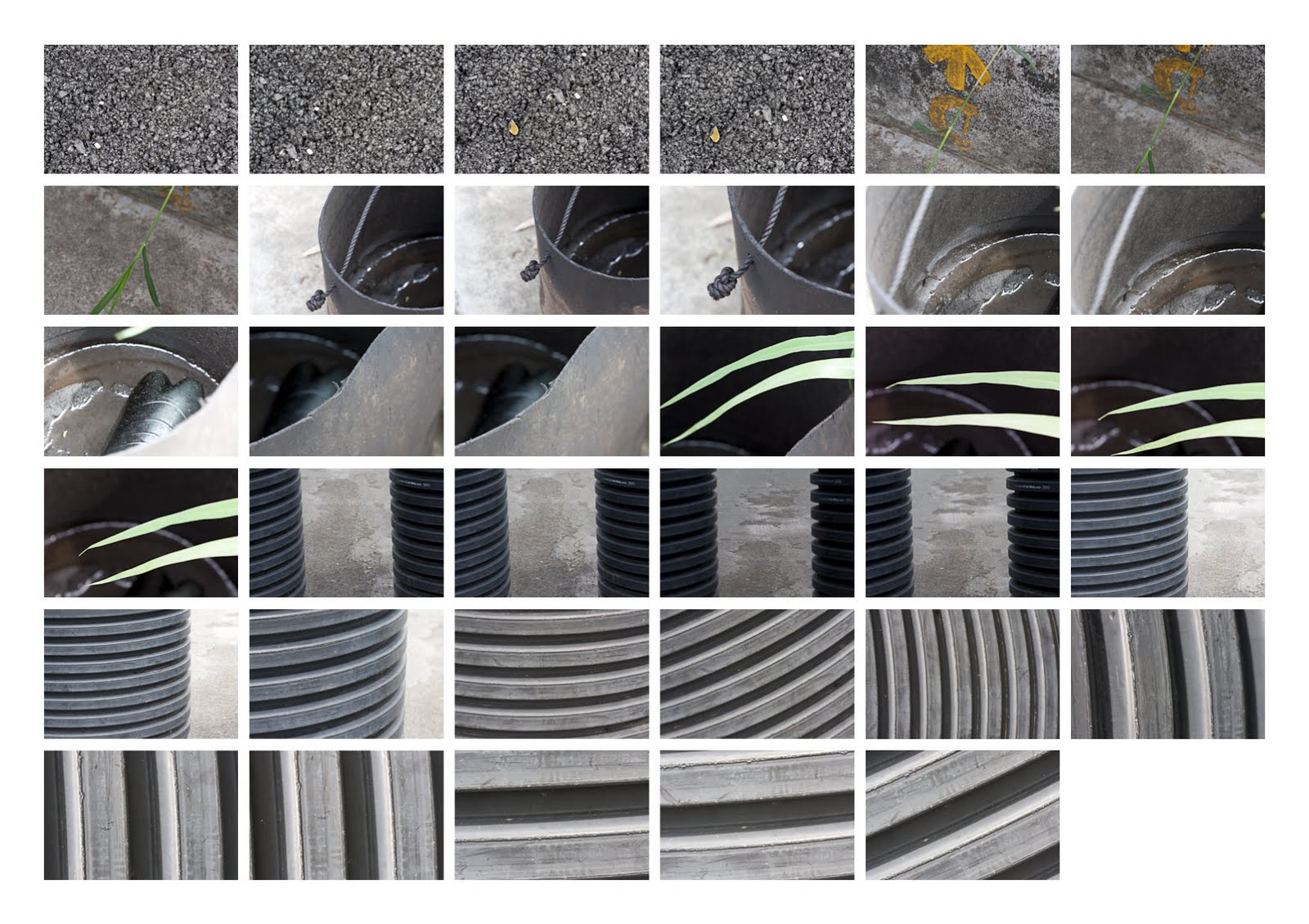
As promised, contact sheets of my raw images for this year's project. Click each set to see it bigger.


 I started my SoFoBoMo project today, going out and getting in the first batch of photos. Despite a short session, I got 287 frames to get me going. The most I've shot in one go for some time, helped enormously by my forward planning. It's also yielded probably enough to complete the project (although I'll be looking for more and better) which takes the pressure off. As I'm focussing more on the book part than the photo part, I don't need to be so choosy about completing a story or ultimate image quality.
I thought it would be worth sharing, for those new or struggling with this, the forward planning I did that helped make this first photo expedition easy:
1. Selecting a suitable subject. My book title "LineCurveTexture" is an easy way to encompass numerous forms of abstract image which makes getting the 35 relatively easy. that was important for me this year as I want more time for the book design. In the past, I've focussed more on story and kept the book simple.
2. Selecting a suitable location. Given the subject and way I'd be shooting, I had a good location in mind - in the modern vernacular a target rich environment. There are also 2 other ready locations I can use to gather more.
3. Selecting suitable equipment. In this case I'm hand-holding my 100mm macro lens.Abstract images using a macro lens means from a relatively small area I can gather a large number of different images. I only have to move a few inches in any direction to get whole new views.
Bringing all three of these together - subject, location, equipment - makes the photography part relatively easy. And I put some though into making it so.
Whatever your goal is, putting some thought into these three aspects, keeping it quite simple and choosing them to work together will greatly improve the success rate for gathering up enough photos.
As has been done in the past, I'll be posting my out of camera images as contact sheets so you can see the process as it happens.

The official announcement has gone up for the start of SoFoBoMo 2010. The start time is 00:01 on 1st June wherever you are - local time to give everyone an equal chance. Of course, you don't need to start right away just so long as you finish by the end of July.
If you've not already registered, why not?

Just 24h until SofoBoMo 2010 officially starts. Expect an official announcement on the SoFoBoMo website when it happens.
Of course you can start any time in the 2 month window, as long as you're finished and submit your entry by the end of 31st July. If you want to get full advantage of the 31 day window, don't start any later than 1st July.
For my part, I'll be starting next Sunday 6th June, I expect. That gets me in early and gives me chance to get in a second book if the opportunity arises (although I'm not expecting it to do so).
 Moon shot 3, Manila, May 2010
I've been enjoying Mike Johnston's posts on lens kits (part 1 and part 2). It's thinking I've been through many times. I thought I'd share my kit development.
It all started with the basic kit zoom as he describes. My first SLR was purchased in 1996 just after graduation. I bought the basic Canon kit -a lot of camera for relatively little money at the time (now you can get 10x the camera for the same actual money as then). Multi-purpose zoom (35-80, I think). Got the job done, until i got into wildlife photography. So I went long - a 70-300mm being the cheapest way into long reach. With limited means, that proved a nice combination. I did get a wide angle converter for the shorter lens but it's seen precious little action. I just don't see the world in wide angle and these days it's easy enough to stitch panoramas if I want that sort of thing.
However, much like Mike, I think 2 lenses generally suffices but that'll be two different for each scenario. I have many two lens kits:
The walk-around kit (actually a choice between 2 - I carry only the one)
The indoor kit
The rangefinder kit
the LF kit
The sports kit
The travel kit
The landscape kit
The cycling kit
The wildlife kit
You get the picture. I have a trunk full of cameras and lenses. But I mainly carry 2 lenses at a time, sometimes 3, although mostly one of those three is neglected. The selection I have also include a number of primes, some good, some frustrating (e.g. my 50mm f/1.8 is frustrating: all electronic, all plastic, difficult to focus but it was cheap).
So a pair for any given situation and enough choice the cover the lot.
If I was forced into just 2? Tricky. Excluding the wildlife (where the 500mm is invaluable), I reckon my 17-55 and maybe an 85 or 135 would do the job (although I own neither of those primes). Or my 70-200 of the current stock. Force me to go prime? then I'd stick with the rangefinder and the 40mm and 75mm. As nice combo for a wide range of situations.
I o see the attraction of micro four-thirds, however. Small cameras and small lenses for the longer reach I like. If a decent camera comes along, I'd snap it up with a couple of lenses to cover most of my going about, travelling applications.
Normally I've got a bunch of project ideas and I already have several long-term projects on the go but this year I've been struggling for ideas for SoFoBoMo. Finally I've hit on a good idea that will be easy to photograph so that I can focus on the book making bit. It also should mean I can avoid too much time outside as right now the weather is far too hot to be wandering around for hours.
I'm not going to reveal the project details just yet - I'll save that for when I get started. Looks like just the one submission this year, too (compared to the 2 in 2008 and 4 last year, that makes it seem like I'm slacking).
Recently on TOP was one of the "Random Excellence" posts, highlighting a series of Vietnam war shots published by the Boston Globe. looking through them I realised that this shot
 From Boston Globe's "The Big Picture"
Nothing to do with photography, I've a new blog as a place for me to air stuff that I've been thinking about. Rantings and ramblings, stuff I might debate down the pub etc. saves it getting all pent up in my brain. But it would also be good if some conversation/debate/argument came of it. You won't agree with most stuff I write - I think in a different way to other people. And if you want to stick to photography, no need to go anywhere.

 Posts
All Comments
Posts
All Comments